
Energy · Energy sector (Chile)
AI applied to energy regulation: anticipated regulatory impact
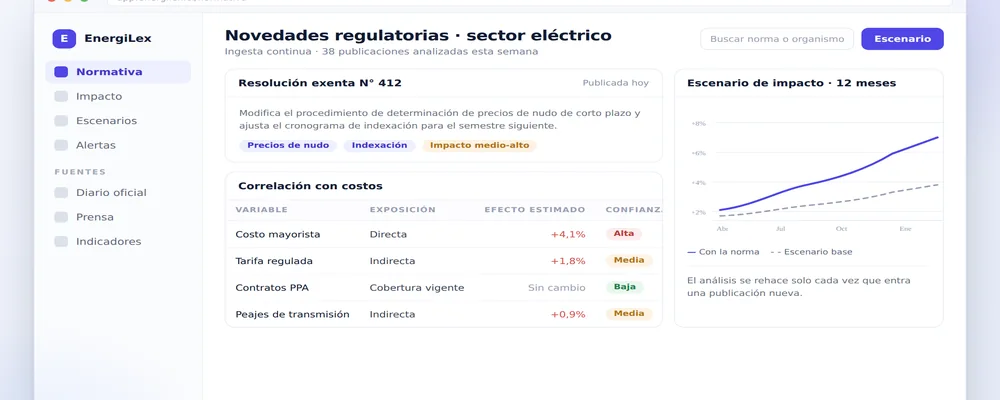
The regulation enters as soon as it's published, is correlated with energy cost, and shows the impact scenario before it reaches the bill.

- Client
- Energy sector (Chile)
- Sector
- Energy
- Product
- EnergiLex
In numbers
The initial problem
The impact of regulatory changes on energy costs was assessed reactively, once the rule was already in force and the decision already made.
The previous process
Regulatory monitoring depended on manually reviewing official publications and news, with no integrated reading between legal framework and economic reality.
The solution implemented
Automatic ingestion of legislation, news, and socioeconomic context, with reasoning models that correlate regulatory changes with energy costs and anticipate impact scenarios.
How we did it
Ingestion of regulatory sources
We automated the capture of legislation, official publications, and Chilean energy sector news as soon as they are published.
Correlation with economic reality
We cross the regulatory framework with cost variables and socioeconomic context, to read the rule in business terms.
Impact scenarios
Reasoning models that anticipate how each change plays out and allow planning before the impact materializes.
Integrated systems
- Regulatory sources
- Sector news
- Reasoning models
- Cloud
The result
An integrated view between legal framework and economic reality, with anticipated scenarios for energy planning.
What changed in the operation
- Regulatory monitoring is no longer manual and reactive.
- Each change is read in terms of impact on costs.
- Planning relies on scenarios rather than assumptions.
- The team joins the regulatory conversation earlier.
Frequently asked questions about this case
Can it be replicated for another country or regulated industry?
Yes. What changes are the regulatory sources and economic variables; the ingestion, correlation, and scenario workflow is the same.
How quickly does a new rule enter the system?
Ingestion is continuous: the publication is incorporated as soon as it appears in the official source and becomes available for analysis.
Does it replace the legal team's analysis?
No. It organizes the material and front-loads the cost cross-check so professional analysis starts from an already processed base.
Keep exploring
Other work by the team, across different sectors.
 Agriculture
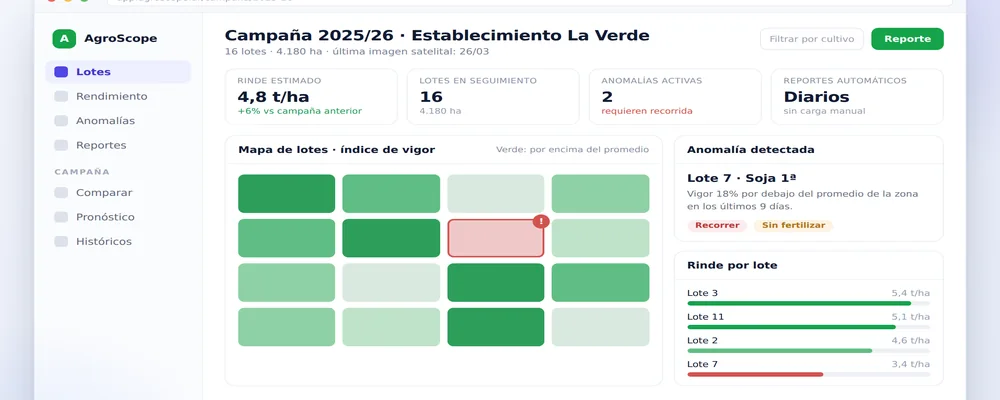
Data analytics for agriculture: field decisions with same-day data
Production and geospatial data turned into season dashboards, with early anomalies and comparison between fields.- Early anomalies
- Benchmarking between fields
- Yield forecasting
 Finance
AI for finance: market data in real time
Automatic ingestion of market sources and a RAG agent to query assets, scenarios, and context in natural language.- Multichannel ingestion
- Natural language queries
- Answers with sources

 Accounting
Accounting automation with AI and tax filings
A workflow that receives, reads, validates, and files the firm's source documents with no typing, plus missing-item alerts per client.- Reading with OCR and AI
- Validation against ARCA and banks
- Alerts for missing documentation
Tell us which process you'd like to improve
We'll look at how it works today and send back a concrete diagnostic: what to automate, how, and what result to expect. No cost, no commitment.